
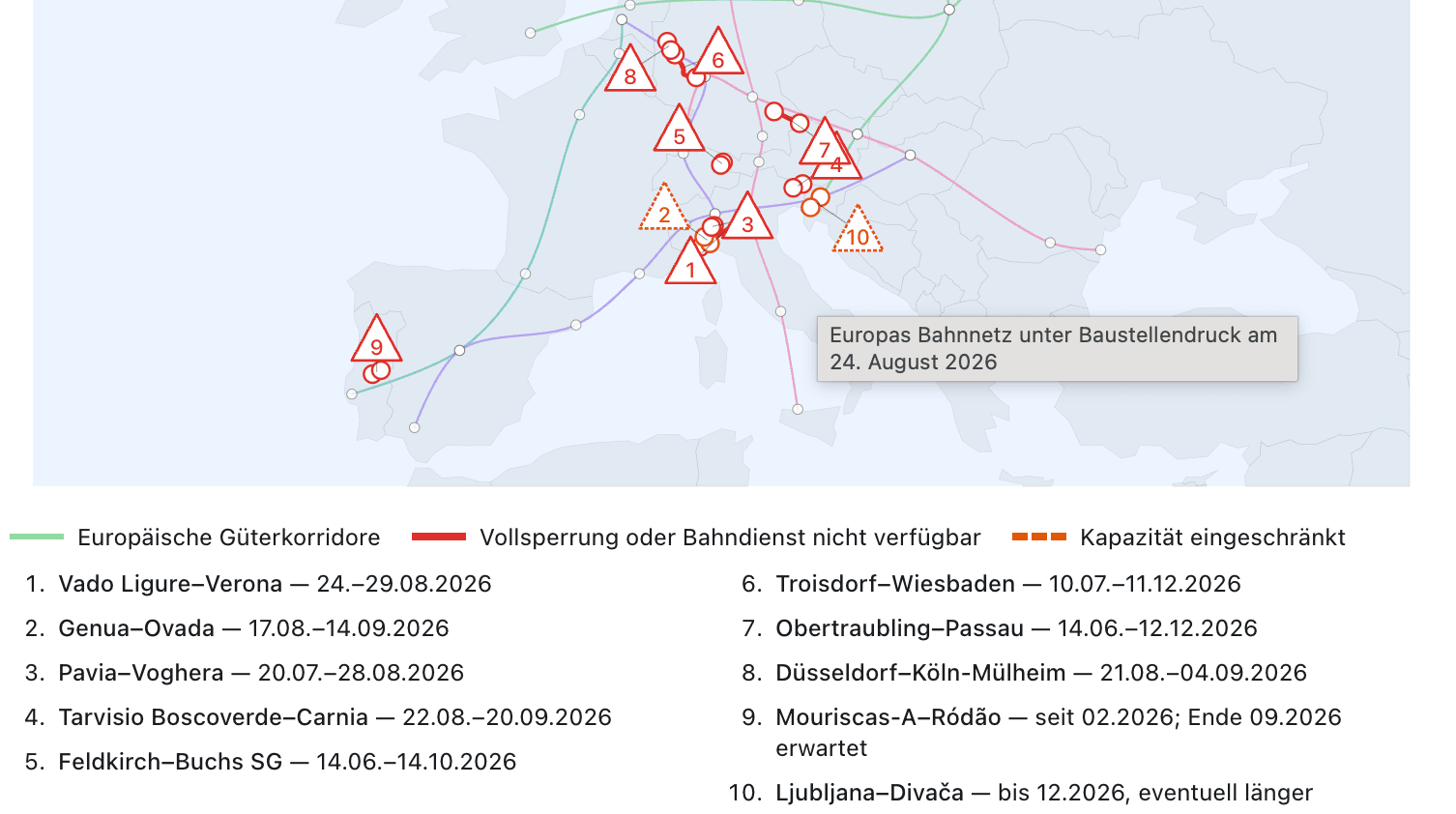
Since August 24, the Maersk rail service between Vado Ligure and Verona has been interrupted. The restriction is expected to last until August 29. At the same time, the route via Ovada remains closed until September 14. This can particularly affect large 40-foot containers from Ligurian ports.
Maersk warns of reduced capacity, delays, and short-notice train cancellations. Alternative rail routings are partially possible. However, they extend transit times and offer less flexibility if delays have already accumulated. In most cases, trucks remain the only alternative. According to Maersk, customers generally bear the additional costs for such emergency solutions.
The problem is not limited to Italy. As of August 24, several important routes are simultaneously closed or severely restricted:
-
The right Rhine route Troisdorf–Wiesbaden is completely closed until December 11. Freight trains must divert to other, already heavily burdened routes.
-
Between Obertraubling near Regensburg and Passau, a major overhaul is underway until December 12. According to ÖBB, approximately 120 freight trains per day are being routed via alternative routes.
-
Between Düsseldorf and Cologne-Mülheim, the main route is completely closed until September 4.
-
Between Tarvisio Boscoverde and Carnia in northern Italy, no trains can run until September 20. According to ERFA, there is no viable detour via Slovenia available for freight traffic.
-
Feldkirch–Buchs SG remains closed until October 14. The connection runs through Liechtenstein and links Austria with Switzerland.
-
On the Milan–Genoa axis, the Pavia–Voghera section is interrupted on both tracks until August 28. After that, one track remains closed until the end of September.
-
According to ERFA, Portugal's Beira Baixa line remains partially completely interrupted. Reopening is expected in September.
-
Between Ljubljana and Divača, the route is not completely closed. However, according to ERFA, the available number of slots has been reduced by approximately 20 percent per railway operator.
The industry association ERFA therefore warns of a European coordination problem. Construction sites are too often planned simultaneously. Detour routes are sometimes also closed, not electrified, or only suitable for shorter and lighter trains.
This puts modal shift under pressure. This refers to the desired shift of goods from road to rail. If shippers permanently switch to truck transport due to unreliable transit times, these volumes later become difficult to return to rail.